AI chatbot for e-commerce: what it can handle in a sale
A store chatbot answers order status, returns and product questions in seconds, and hands angry customers to a person. What to set up before a sale.
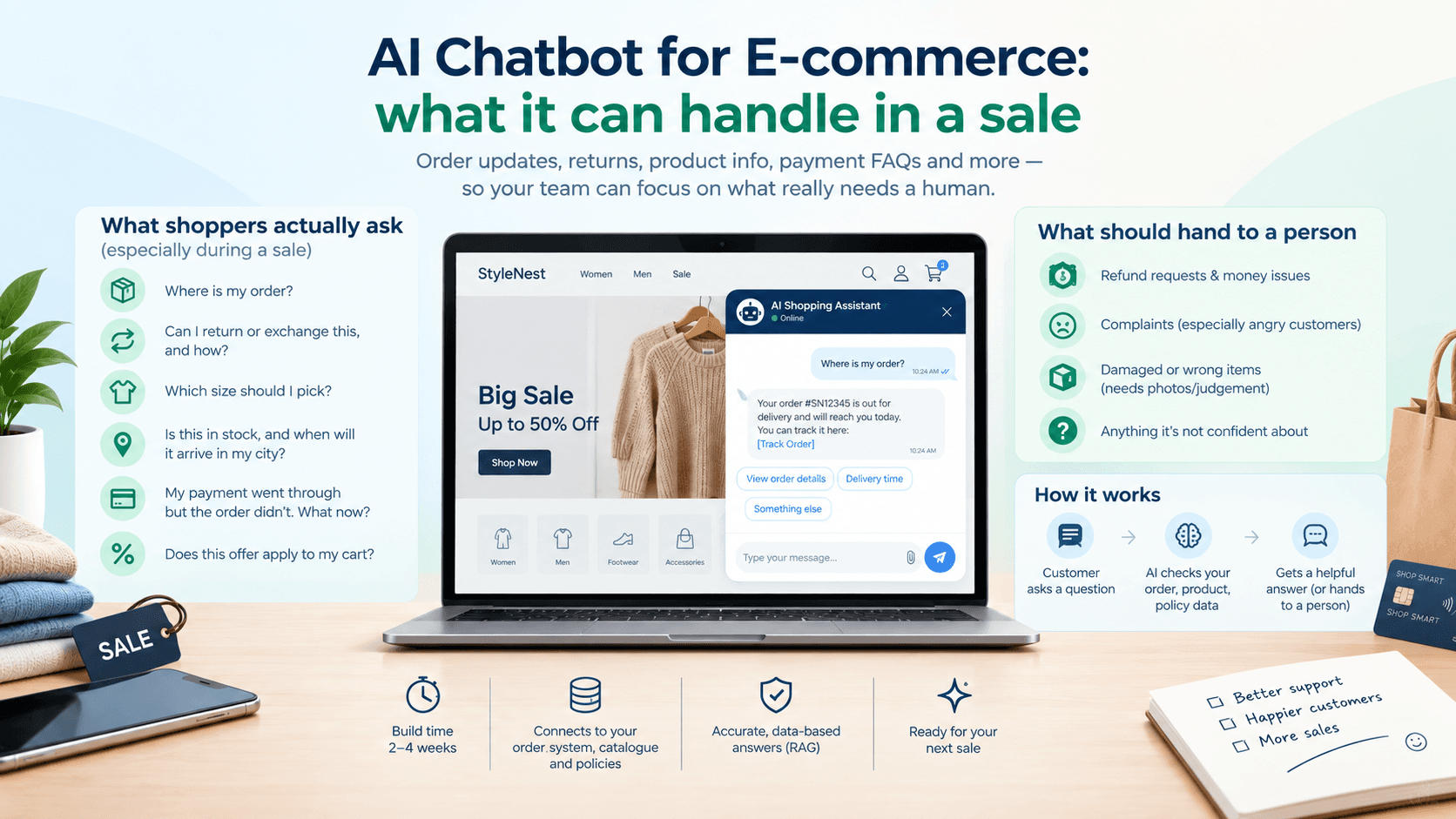
An AI chatbot for an online store can reliably handle order status questions, return and exchange rules, sizing and product questions, and payment or delivery FAQs, which together make up most of the messages a store gets during a sale. It should hand refunds, complaints and anything unusual to a person. A focused store chatbot connected to your order system usually takes two to four weeks to build and test, so for a festive or Black Friday sale, the time to start is now.
The difference between a chatbot that helps and one that annoys people comes down to what it's connected to and what it's allowed to decide.
What shoppers actually ask during a sale
Look at your support inbox from last year's busiest week and you'll likely see the same few questions over and over:
Where is my order?
Can I return or exchange this, and how?
Which size should I pick?
Is this in stock, and when will it arrive in my city?
My payment went through but the order didn't. What now?
Does this offer apply to my cart?
In most stores, "where is my order" alone is a large share of all messages after a sale. Every one of these has an answer that exists somewhere in your systems. That's what makes them good chatbot work.
What to give the bot and what to keep human
What a store chatbot can handle well
A chatbot is useful when it can look things up, not when it guesses. The best store bots are connected to:
Your order system, so it can check the status of an order from a phone number or order ID and give the tracking link.
Your product catalogue, so it can answer "does this come in blue?" or "what's the fabric?" from real product data.
Your policies, so it answers return windows and delivery times from the text you wrote.
Your size charts, and ideally past return reasons, so sizing advice matches how your products actually fit.
With those connections, a modern language model can answer in plain, friendly language, in English or Hindi or a mix, at 2am, during the busiest hour of the year.
What it should hand to a person
Some messages need a human, and a good bot recognises them and says so quickly:
Refund requests and anything involving money going back.
Complaints, especially from customers who are already angry.
Damaged or wrong items, which usually need photos and judgement.
Anything the bot isn't confident about.
The handoff should pass the whole conversation to your team, so the customer doesn't repeat themselves. Nothing makes a shopper angrier than explaining a problem twice.
How to keep it from making things up
The risk with AI chatbots is confident wrong answers: a return policy that doesn't exist, a discount you never offered. You prevent that with how the bot is built, not with hope.
Answer from your data only. The bot retrieves the relevant policy or product record and answers from it. This approach is called RAG, which we explain in RAG for business.
Give it a narrow job. A store bot doesn't need opinions on politics or recipes. It should politely decline anything off-topic.
Never let it promise money. Discounts, refunds and compensation go to a person.
Test with real questions. Before launch, run a few hundred real past messages through it and check the answers. This is the step most teams skip.
What it costs and how long it takes
For a focused store chatbot connected to orders, catalogue and policies, expect two to four weeks of build and testing. Costs depend on how many systems it connects to. Our guide to AI chatbot costs and ROI breaks down the range, from simple FAQ bots to fully integrated support agents.
Running costs are usually small next to support salaries. Each AI answer costs a fraction of a cent to a few cents in model fees, depending on the model and how much context it reads.
A four-week plan that lands before the sale
If your sale starts in early November, a realistic plan starting in early October looks like this:
Week 1: connect the bot to your order system and catalogue, and load your return, delivery and payment policies.
Week 2: run a few hundred real questions from last year's inbox through it. Fix every wrong or vague answer, usually by tightening the policy text it reads.
Week 3: go live on your website for a slice of visitors, with a clear "talk to a person" button. Watch every conversation for a few days.
Week 4: open it to everyone, and add WhatsApp if your customers prefer it.
The testing in week 2 matters more than which AI model you pick. Most bad chatbot answers trace back to unclear source text, such as a return policy that says "7 days" in one place and "10 days" in another. The bot faithfully repeats the confusion. Cleaning up that text helps your human team too.
Chatbots and other AI in fashion e-commerce
Support isn't the only place AI helps a store. For fashion, the biggest problem is often fit and look: shoppers hesitate because they can't picture the item on themselves, and returns eat the margin.
That's the problem we worked on with VESTON, a fashion store where shoppers upload a photo and see themselves in an outfit before buying. A chatbot answers questions. Try-on answers the doubt behind many of those questions. We wrote more about it in AI virtual try-on for fashion stores.
Questions about e-commerce chatbots
Can a chatbot track orders automatically?
Yes, if it's connected to your order system or shipping provider. The shopper gives an order ID or phone number, and the bot fetches the live status and tracking link.
Will an AI chatbot replace my support team?
No. It takes the repetitive questions off their plate, so they can spend time on refunds, complaints and the customers who need a person. Most stores keep the same team and handle a much bigger sale.
Can the chatbot work on WhatsApp as well as my website?
Yes. The same assistant can answer on your website chat and on WhatsApp, which is where many shoppers in India prefer to ask. See our guide to the WhatsApp Business API for the WhatsApp side.
How do I stop a chatbot giving wrong answers?
Make it answer only from your own data, keep its job narrow, send anything about money to a person, and test it on hundreds of real past questions before launch.
Get a chatbot ready before the rush
If you want a store assistant live before your next sale, tell us about your store and your busiest questions. Our AI solutions team will tell you honestly whether a chatbot is worth it for your volume, and what it would cost.