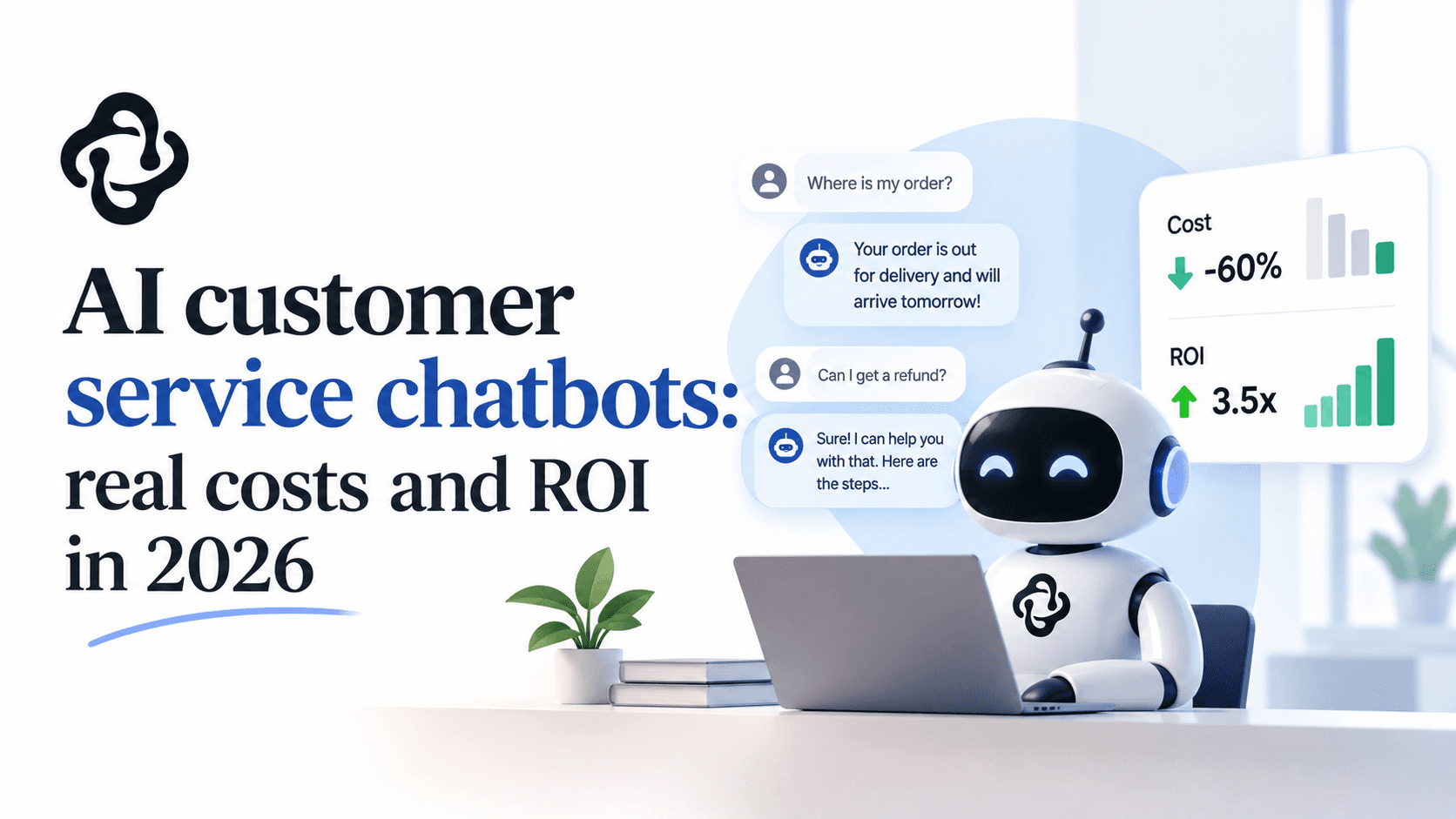
AI customer service chatbots: real costs and ROI in 2026
A production AI support bot costs $5,000 to $60,000, deflects 45 to 65% of routine tickets, and pays back in 6 to 9 months. The honest math.
A production-grade AI customer service chatbot costs $5,000 to $60,000 to build in 2026, handles 45 to 65 percent of routine inquiries without a human, and typically pays for itself within 6 to 9 months. Those are the defensible numbers; the 80 percent cost-reduction headlines in vendor decks are not. This guide covers what AI support actually costs, what it returns, and the design decisions that separate the chatbots customers thank from the ones they scream at.
The honest math on AI support in 2026
Start with the unit economics, because they explain everything else. Industry benchmarks put a human-handled support ticket at $6 to $12 in fully loaded cost. An AI-handled ticket runs $1 to $2 at scale. That's not a marginal improvement; it's a different cost structure, available around the clock in every language you sell in.
The aggregate numbers follow from it. 2026 benchmark reports on AI customer service cluster around these figures:
Deflection of 45 to 65 percent of tier-1 contacts (order status, returns, how-do-I questions) for well-implemented deployments.
Support cost reduction of 30 to 40 percent in the first year. Realistic net savings, after the build and running costs, land closer to 20 to 35 percent, which is still a large number on any real support budget.
First-year ROI averaging around 340 percent across published studies, roughly $3.50 back per dollar spent, with payback inside 6 to 9 months for mid-market deployments.
Now the caveat the vendors skip: the same 2026 research shows hallucination rates of 15 to 27 percent in unconstrained deployments, falling below 2 percent only when the bot is held strictly to approved source material. The entire difference between a support asset and a liability lives in that sentence, and it's a build decision, not a model choice.
What an AI support chatbot costs to build
Off-the-shelf chatbot SaaS runs $50 to $500 a month and works when your needs are generic and your knowledge base is already tidy. Custom builds earn their cost when the bot must know your products, respect your policies, and act inside your systems. Bands we quote and see quoted:
$5,000 to $15,000: a grounded Q&A bot. It answers from your documentation, help center, and policies, refuses to answer beyond them, and hands off to a human cleanly. One channel (web widget), solid analytics.
$15,000 to $40,000: a support agent that acts. Order lookups, booking changes, refund eligibility checks against your live systems, conversation memory, and escalation with a full summary attached so customers never repeat themselves. Multi-channel (web, WhatsApp, email).
$40,000 to $60,000+: support automation as infrastructure. Multiple brands or languages, deep helpdesk integration (Zendesk, Intercom, or your own), agent-assist mode drafting replies for your human team, and evaluation dashboards tracking accuracy weekly.
Running costs: model usage for a mid-sized deployment typically lands between $100 and $2,000 a month, plus ordinary hosting. Budget a maintenance allowance too; your products change, and a bot answering from last quarter's policy is worse than no bot.
Where the ROI actually comes from
Ticket deflection gets the headlines, but the returns stack from several directions at once:
Coverage counts as much as cost. The bot answers at 2 a.m. on a Sunday, in the customer's language. For e-commerce, that's revenue: an unanswered pre-sale question is an abandoned cart. Conversational AI is projected to save $80 billion in contact-center labor globally by 2026, but for a small business the sharper effect is never missing the buying-intent question.
Your human team gets the good work. When the bot absorbs the repetitive half, humans handle the complex, high-emotion, high-value conversations. Response times drop on those too, because the queue is shorter.
The transcripts are a product goldmine. A thousand bot conversations a month tell you exactly what confuses customers, which pages fail them, and what feature they keep asking for. Most companies pay for research like that.
Agent assist multiplies before it replaces. The same grounded system that answers customers can draft replies for your human agents to approve. Teams commonly see agents handling meaningfully more conversations per hour with this alone, and it carries none of the public-facing risk.
The design decisions that decide everything
We build support assistants inside our AI software development practice, and the difference between the loved ones and the loathed ones comes down to five choices:
Ground it or don't ship it. The bot answers only from approved sources, cites where its answer came from, and says "I don't know, let me get you a person" past its confidence threshold. This is the choice that moves hallucination from 20 percent to under 2.
Make escalation instant and shameless. The fastest way to make a customer furious is trapping them in a bot loop. One request for a human gets a human, with the conversation summary attached. Counterintuitively, easy escalation increases bot usage, because trying it costs nothing.
Let it do things, carefully. "Where is my order?" answered generically is a deflection statistic. Answered with the actual tracking link, it's service. Actions on live systems (lookups first, changes later, refunds behind approval thresholds) are where satisfaction jumps.
Watch it weekly. An evaluation set built from your real historical tickets, scored on every prompt or model change. Accuracy is a metric on a dashboard, not a feeling.
Start narrow. Launch on your top 20 question types, which typically cover 60-plus percent of volume, and expand from data. Bots that try to answer everything on day one embarrass everyone on day two.
When a chatbot is the wrong answer
Honesty clause. Skip the bot, or delay it, when:
Your support volume is small. Under roughly 300 tickets a month, the build cost struggles to pay back; a great help center and fast email answers win. (The help-center content, ironically, is also what a future bot will need.)
Your documentation is a mess. A bot grounded in wrong documents is a confident liar. Fix the knowledge base first; sometimes that alone drops ticket volume enough to change the decision.
Your support is your differentiator. If customers choose you because a human answers, automate the lookup work behind that human instead of replacing them. Agent assist gives you most of the economics with none of the brand risk.
A worked ROI example you can copy
Here's the scoping math with illustrative numbers; swap in your own from last month's helpdesk report.
An online retailer handles 2,000 tickets a month. Reading a sample shows 62 percent are routine: where's my order, how do returns work, size questions, invoice copies. At $8 per ticket loaded cost, support runs $16,000 a month, with the routine slice at roughly $9,900.
A grounded, action-taking bot in the $25,000 band that resolves 75 percent of that routine slice removes about 930 tickets a month, roughly $7,400 in monthly labor capacity. Add the running costs ($600 a month, generously) and subtract 15 percent of the savings for humans reviewing escalations and low-confidence answers. Net monthly benefit: about $5,700. Payback: month five. From there it compounds, because ticket volume grows with the business while the bot's cost mostly doesn't.
Now run the same numbers at 250 tickets a month: net benefit lands near $700 a month and payback stretches past two and a half years, before counting your time on the project. That business should buy a $100-a-month SaaS widget or just write better help pages. Both answers are correct; the volume decides, which is why we ask for your ticket counts before quoting anything.
Buy off-the-shelf or build custom: the four-question test
The $50-a-month SaaS bot and the $25,000 custom build both have legitimate homes. Four questions separate them:
Does the bot need to act on your systems? Checking a live order, changing a booking, or processing a refund requires integration work that subscription widgets don't do deeply. Answering from documents alone, they handle fine.
Is your knowledge simple and public? If everything the bot needs is already on your help center, off-the-shelf grounding works. If answers depend on the customer's account, order history, or contract tier, you're in custom territory.
Do you need control over tone, escalation, and data? SaaS bots come with their vendor's defaults and your data in their cloud. Regulated businesses and strong brands usually can't live with either.
Will volume make per-conversation pricing hurt? Subscription bots price per resolution or per conversation; at thousands of monthly conversations, the subscription math crosses the custom-build math within a year or two.
Two or more answers pointing custom, and the build pays for itself. All four pointing off-the-shelf, and we'll happily tell you to go subscribe to something; it's the correct engineering answer and it keeps our advice worth taking.
Key takeaways
Custom AI support bots cost $5,000 to $60,000 in 2026; grounded Q&A starts around $5,000, action-taking agents from $15,000.
Realistic performance: 45 to 65 percent tier-1 deflection, 20 to 35 percent net first-year cost reduction, payback in 6 to 9 months.
AI tickets cost $1 to $2 against $6 to $12 for human-handled ones, and the bot works nights, weekends, and every language.
Hallucination is a build choice: strict grounding takes it from roughly 20 percent to under 2. Never ship an ungrounded support bot.
Easy human escalation is the single biggest driver of customer acceptance.
Questions businesses ask us about support chatbots
How is this different from the chatbot widgets we've all hated for years?
Those were decision trees: keyword matching and canned replies. Modern grounded assistants read your actual documentation, understand the question as asked, and answer specifically, or hand off when unsure. The technology changed categories around 2023; public perception is still catching up, which is why the escalation design matters so much.
Can the bot handle refunds and account changes safely?
Yes, with thresholds. Typical pattern: the bot checks eligibility against your policy and processes low-value refunds automatically, while anything above a limit or outside policy goes to a human with the case pre-assembled. You set the limits; every action is logged.
What do we need to have ready before building one?
Three things: reasonably current documentation or a help center, access to the systems the bot should read from (orders, bookings, accounts), and a sample of historical tickets so we can build the evaluation set. If the documentation is thin, that's the first two weeks of the project.
Will it work in multiple languages?
Yes, and this is one of the quiet wins. A grounded assistant answers in the customer's language from your English documentation with no extra content work. For anyone selling across regions, that's support coverage that was previously unaffordable.
How long does it take to launch?
A grounded Q&A bot: 3 to 6 weeks. An action-taking support agent: 6 to 12 weeks depending on integrations. We ship in milestones, so you see it answering real (test) tickets within the first couple of weeks either way.
Run your own numbers
Take last month's ticket count, multiply by 0.5, and multiply that by what a ticket costs you. That's the monthly saving a well-built bot targets, before the revenue effects. If the number looks meaningful, book a free scoping call and we'll tell you which band your case falls into and what it would cost, fixed-scope, no surprises.