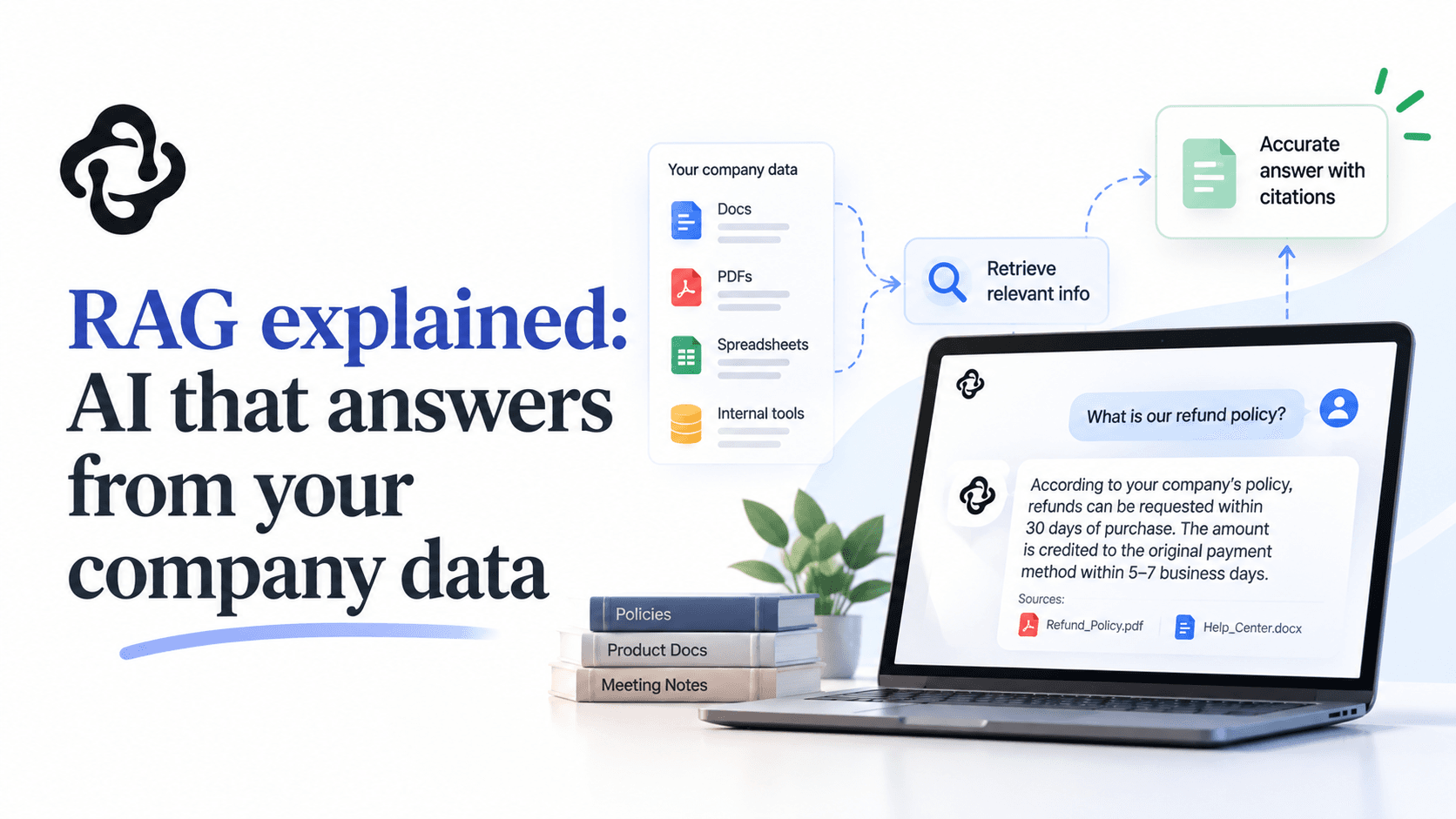
RAG explained: AI that answers from your company data
RAG lets AI answer from your own documents with citations instead of guessing. How it works, what it costs, and how to know you're ready.
RAG, short for retrieval-augmented generation, is the technique that lets an AI assistant answer questions from your company's own documents instead of guessing from its training data. It works by finding the most relevant passages from your files first, then having the language model write its answer only from what it found. In 2026 a working RAG system for a business costs roughly $10,000 to $75,000 to build, and it has become the standard way companies make AI trustworthy enough for real work. Here's how it works in plain language, what it's good for, and how to tell if your company is ready for one.
The problem RAG solves
Ask a plain language model a question about your company ("What's our refund policy for annual plans?") and you get one of two bad outcomes: a refusal, because it has never seen your policy, or worse, a fluent invented answer. Language models are trained on the public internet. Your contracts, policies, product specs, and past project notes are not in there, and shouldn't be.
RAG fixes this with a step that happens before the model writes anything:
Your documents are indexed. Policies, wikis, PDFs, tickets, product data get split into passages and stored in a form that can be searched by meaning as well as by keyword.
A question comes in. The system searches that index and pulls the handful of passages most relevant to the question.
The model answers from those passages only. It's instructed to use what was retrieved, cite where each claim came from, and say so when the answer isn't in the documents.
The difference in reliability is dramatic. 2026 support-industry benchmarks show unconstrained chatbots hallucinating in 15 to 27 percent of answers, while systems held strictly to retrieved source material get below 2 percent. Same models. The retrieval is the trust.
Why businesses are adopting it now
Two numbers explain the rush. McKinsey's research has 71 percent of organizations using generative AI in at least one business function, and workplace studies consistently find knowledge workers spending around 9 hours a week just looking for information they know exists somewhere. Gartner-cited surveys in 2026 found two thirds of Fortune 500 companies deployed or actively building RAG systems, and market researchers project the RAG market growing from about $3.3 billion in 2026 at over 40 percent a year.
But the adoption isn't really about the trend line. It's that RAG turns a company's oldest liability, the sprawling pile of documents nobody can search, into the thing that makes its AI smarter than everyone else's. Two competitors can call the same OpenAI or Anthropic API. Only one of them has your twelve years of project notes, support history, and pricing decisions wired into it.
What companies actually use RAG for
The use cases that keep proving out:
Internal knowledge assistants. "How do I file this expense?" "What did we quote this client last year?" "Which version of the contract template is current?" Every answer that took a Slack interruption or a 40-minute search now takes seconds, with a citation.
Customer support grounding. The public face of RAG. A support assistant that answers from your real documentation, accurately, in any language. We covered the economics in depth in our work on support automation; deflecting half of tier-1 tickets is the norm, not the exception.
Document-heavy operations. Teams that live in contracts, compliance rules, insurance policies, or technical manuals use RAG to ask questions across thousands of pages at once. "Which of our active contracts have a change-of-control clause?" is a week of paralegal time or one query.
Onboarding and training. New hires ask the assistant the questions they're embarrassed to ask twice. Time-to-productive shrinks, and the questions they ask become a map of what your documentation is missing.
Sales knowledge. Proposals, case studies, and past pricing at the fingertips of whoever is writing the next pitch, without raiding three drives and a veteran's memory.
The shared pattern: the company already owns the knowledge. RAG just makes it answer questions.
What a RAG system costs to build in 2026
Bands from our own scoping and consistent with published 2026 guides:
$10,000 to $25,000: a focused assistant over one clean knowledge source. Your help center or policy wiki, a chat interface, citations, and honest "I don't know" behavior.
$25,000 to $75,000: the version most mid-sized companies actually need. Multiple sources (drive, wiki, helpdesk, database), permission-aware retrieval so people only get answers from documents they're allowed to see, evaluation suites, and integration into the tools your team lives in (Slack, your CRM, your product).
Above $75,000: enterprise concerns. Knowledge graphs for heavily interconnected data, strict residency requirements, self-hosted models, very large document sets with complex access rules.
Running costs are modest: model usage plus hosting typically lands in the hundreds of dollars a month for internal tools. The recurring investment that matters more is editorial: someone has to own keeping the source documents current, because the assistant is exactly as accurate as what it reads.
The three things that make or break a RAG project
We build these systems inside our AI software development practice, and success is decided by three unglamorous factors:
Document hygiene beats model choice. If three versions of the leave policy live in three folders, the assistant will cite the 2022 one eventually. The first weeks of a good RAG project are an audit of what's current, what's duplicated, and what's missing. Companies that skip this ship a confident liar.
Permissions are a feature, not an afterthought. The assistant must respect who can see what. Salary bands in retrievable HR docs will surface in an answer sooner or later. Permission-aware retrieval is a 2026 baseline requirement, and it's engineering work, so it belongs in the quote.
Evaluation from day one. Before launch, we build a test set of real questions with known correct answers and score the system against it on every change. "It seemed good in the demo" is how RAG projects die in month three.
Get those three right and the model choice becomes almost boring; we benchmark GPT, Claude, and Gemini against the actual task and pick whichever wins on your documents.
Do you need RAG, fine-tuning, or neither?
Quick decision guide, since the terms get sold interchangeably:
RAG is for knowledge: answering from facts that live in documents and change over time. Update the document, the answer updates. This covers the large majority of business cases.
Fine-tuning is for behavior: teaching a model a style, format, or narrow skill. It does not reliably teach facts, and it goes stale the moment your facts change. Some systems eventually use both; almost none should start with fine-tuning.
Neither, if your knowledge fits in a page. A model can be handed a short document with every question; no retrieval needed. If your entire policy set is ten pages, a simpler build wins.
A useful readiness test: pick the ten questions your team answers repeatedly, and check whether a current, correct written answer exists somewhere for each. Seven or more yes: you're RAG-ready. Fewer: fix the documents first, which is worth doing regardless.
The pipeline in plain terms, step by step
You don't need to build this yourself, but seeing the moving parts makes vendor conversations concrete. A production RAG system is a pipeline with five stations:
Ingestion. Connectors pull documents from where they live (drive, wiki, helpdesk, database) on a schedule, so the index tracks reality instead of a one-time snapshot. When a policy changes on Tuesday, Wednesday's answers reflect it.
Chunking and indexing. Documents get split into passages sized for retrieval, tagged with their source, date, and access permissions, and stored in a vector database that searches by meaning.
Retrieval. A question comes in; the system finds the most relevant passages, filters out anything this user isn't permitted to see, and often re-ranks the results so the best evidence rises.
Generation. The model receives the question plus the retrieved passages and writes an answer grounded in them, with citations back to each source document.
Evaluation and logging. Every question, retrieval, and answer is logged; a scored test set runs on every change. This station is the difference between a system that improves and one that quietly rots.
Most quality problems trace back to stations one and two, and most trust problems to the permission filtering in station three. When you evaluate vendors, ask how each station works; a builder who can't explain their chunking and permission strategy in plain language hasn't built many of these.
A readiness checklist before you spend anything
Five questions, answerable in an afternoon, that predict whether a RAG project will succeed at your company:
Can you name the ten questions your team answers most? If nobody can list them, usage will disappoint, because demand was imagined rather than observed.
Does a correct written answer exist for at least seven of the ten? The system retrieves; it doesn't invent knowledge you never wrote down.
Do you know who may see what? If permissions live in people's heads ("everyone knows not to share that folder"), write them down first; the assistant will enforce exactly what's encoded and nothing else.
Is there an owner? One person who curates sources, reviews flagged answers weekly, and owns accuracy. Half a day a week is usually enough; zero is fatal.
Can you measure the before? Count the interruptions, the repeated questions, the search time, for two weeks. Without a baseline, the project can't prove itself, and projects that can't prove themselves lose budget.
Score five yes: proceed with confidence. Three or four: proceed, but budget the gaps into phase one. Fewer: spend the money on documentation first, which costs a fraction as much and is a prerequisite anyway.
Key takeaways
RAG makes AI answer from your documents with citations instead of guessing, cutting hallucination from roughly 20 percent to under 2 in support benchmarks.
Businesses use it for internal knowledge, support, contract-heavy operations, onboarding, and sales enablement. The pattern: knowledge you own, finally answering questions.
A focused system costs $10,000 to $25,000; the multi-source, permission-aware version most companies want runs $25,000 to $75,000.
Document hygiene, permissions, and evaluation decide the outcome. The model choice matters least of the four.
RAG is for facts that change; fine-tuning is for style and format. Buy accordingly.
Common questions about RAG
Is our data safe? Does the AI provider train on it?
Business-tier APIs from the major providers (OpenAI, Anthropic, Google) contractually don't train on your API data, and your documents stay in your own storage; only the passages relevant to each question are sent at query time. For stricter requirements, self-hosted models keep everything inside your infrastructure at a higher build cost.
How is this different from just using ChatGPT?
ChatGPT knows the public internet up to its training date. It has never seen your policies, prices, or project history, and it will improvise when asked about them. A RAG system is your documents plus a model, with citations, permissions, and an honest refusal when the answer isn't in the sources.
How long does it take to build?
A focused single-source assistant: 3 to 6 weeks. Multi-source with permissions and integrations: 8 to 14 weeks. The variable is rarely the AI; it's how scattered the documents are and how many systems we're connecting.
What if our documentation is out of date?
Then that's phase one, and it's not wasted work; companies usually find the documentation cleanup alone reduces repeated questions. We'd rather tell you that in a free scoping call than sell you an assistant that answers from stale files.
Can it write documents too, or only answer questions?
Both. The same grounded setup that answers questions can draft proposals, replies, and reports using your actual past examples as source material, with a human approving the output. Drafting-with-review is often the highest-ROI second phase.
Find out in one call
Bring the ten questions your team answers most, and we'll tell you whether RAG, a simpler build, or a documentation cleanup is the right first move, plus a fixed price for whichever it is. The scoping call is free: digirashtra.in/contact.