How much does it cost to build a SaaS MVP in 2026?
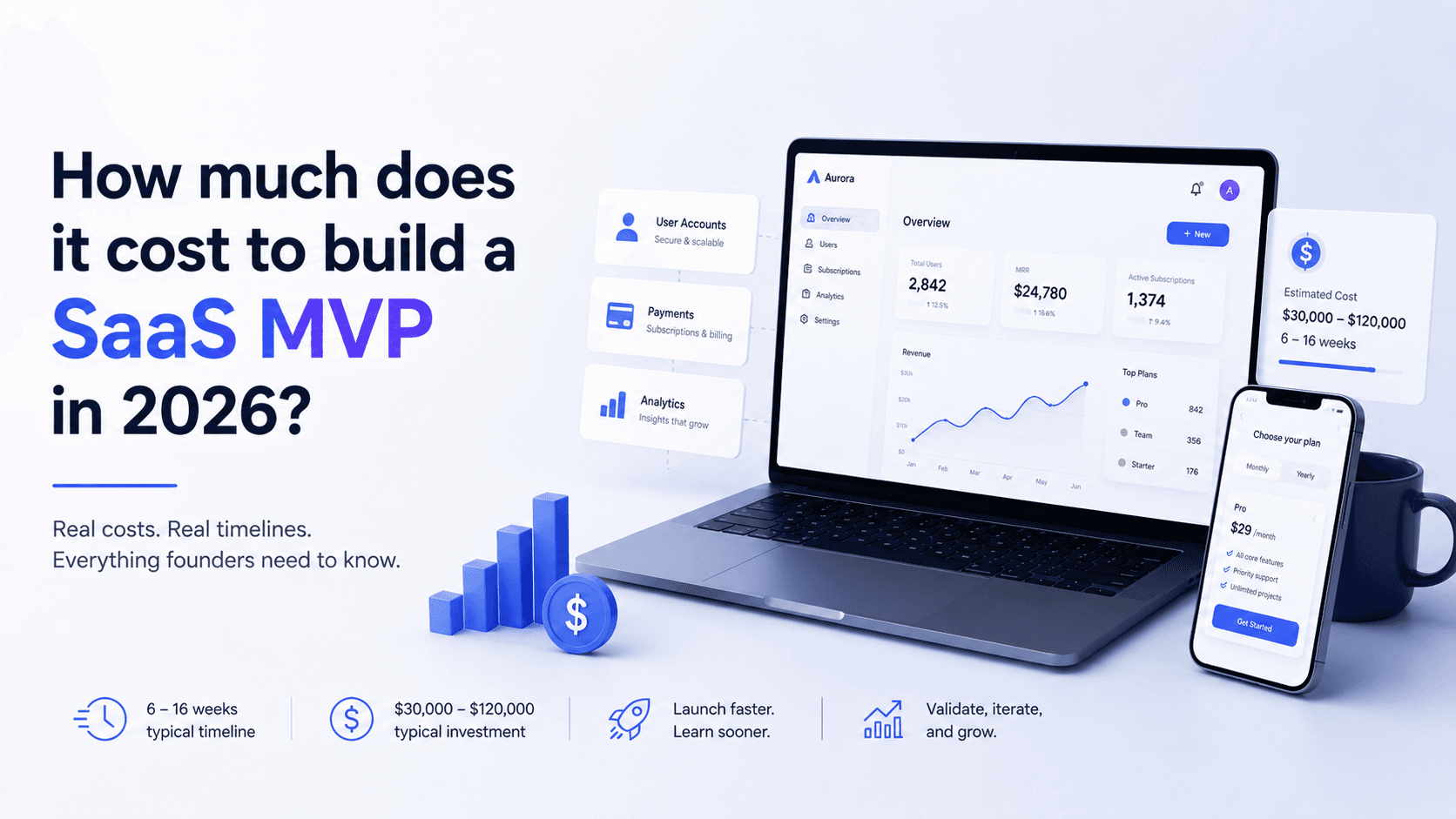
A production-ready SaaS MVP typically costs $30,000 to $120,000 and ships in 6 to 16 weeks. Where the money goes, and where founders overspend.
A production-ready SaaS MVP typically costs between $30,000 and $120,000 and ships in 6 to 16 weeks. The spread comes down to how many user roles you need, how complex your billing is, and how much of the product has to exist before someone will pay for it. Here's where the money actually goes, and where founders reliably overspend.
First, a definition, because the word MVP gets abused. An MVP is the smallest product that can earn its first paying customers. It is a real product with real accounts and real payments. It is smaller than your vision, and that's the point: it exists to find out which parts of the vision customers will fund.
Where the money goes
Every SaaS budget, whatever the idea, splits across the same six pieces.
Accounts and tenancy come first. Sign-up, login, password reset, and the architecture that keeps each customer's data cleanly separated. Tenancy decisions made badly here are the most expensive thing to fix later, which is why they're worth senior hands early.
Billing is second, and it's bigger than founders expect. Plans, checkout, upgrades, downgrades, cancellations, failed payments, invoices. Stripe handles the rails, but the logic around it is real work. Skipping the unglamorous parts, like cancellation flows and webhook handling, creates support tickets forever.
Then the core workflow, the one thing your product does that people pay for. This deserves roughly half the design and engineering attention. Around it sit onboarding (the first ten minutes decide whether a trial converts), an admin view so you can see and help your users, and the design pass that makes the whole thing feel trustworthy enough to type a card number into.
We've broken down how we run these builds on our SaaS product development page.
Where founders overspend
The same four money leaks show up again and again.
Building nine features when two would sell. Every feature you add before launch is a bet placed with no information. After launch, real usage tells you where to spend. Before launch, you're guessing, and guesses are expensive.
Native mobile apps too early. If your buyers live in a browser at work, a solid web app wins the first year. Two native apps can double a budget for users who haven't asked for them yet.
Custom infrastructure. Your MVP does not need a bespoke deployment pipeline or a self-managed database cluster. Boring, managed infrastructure is faster, cheaper, and easier to change later.
Polish in the wrong places. Founders burn weeks perfecting settings screens nobody visits while the signup flow, the thing every single customer touches, gets a day. Spend where the traffic is.
What you can cut without hurting launch
Plenty is safe to postpone. Single sign-on and team permissions can wait until a bigger customer asks. The second and third pricing tiers can wait. Most integrations can wait, pick the one your first customers already use and stop there. Dark mode can definitely wait.
Two things are never safe to cut: working payment flows, including cancellation, and data separation between customers. Cutting either one doesn't save money. It relocates the cost to a worse date.
How long it takes
A focused MVP with one core workflow and straightforward billing ships in 6 to 10 weeks. Add multiple roles, heavier data work, or an AI feature and you're realistically at 12 to 16 weeks.
Be suspicious of both extremes. A two-week quote means a template with your logo on it. A nine-month MVP plan means the scope isn't minimum at all, and the market will have moved by the time you learn anything.
We work in short milestones with something clickable every week or two, so you're never waiting three months to discover what your money bought.
What happens after launch
Launch is the beginning of the actual work: watching real users, fixing what confuses them, and building what they ask for. Budget for iteration, because a SaaS that doesn't change after launch is a SaaS that didn't listen.
Every build we ship includes 30 days of support. After that, most SaaS clients keep a monthly retainer for exactly this iteration loop, and the ones who learn fastest are the ones who ship small changes weekly. You own the code and every account either way, so staying is a choice, never a lock-in. You can see what we've shipped for other founders on our work page.
Questions we hear a lot
Should I build on no-code first? If you can validate the idea with a form and a spreadsheet, do that, it's the cheapest experiment there is. Build real software once people have shown they'll pay. No-code ceilings arrive fast once you have paying customers with requests.
Do I need multi-tenancy from day one? You need clean data separation from day one. The specific architecture (shared database with row-level security versus isolated schemas) depends on your market, and it's a scoping decision, and we'll recommend one and explain why in plain language.
Can I pay with equity? We work for money, and honestly, so does every team you'd want. An agency paid in equity has strange incentives about your burn rate.
How many features should version one have? However many it takes to get one customer to pay. In practice that's usually one core workflow done properly, with accounts and billing around it.
If you have an idea and a rough budget, a scoping call will turn them into a fixed number and a week-by-week plan. Book one here, it's free, and you'll leave with the plan either way.