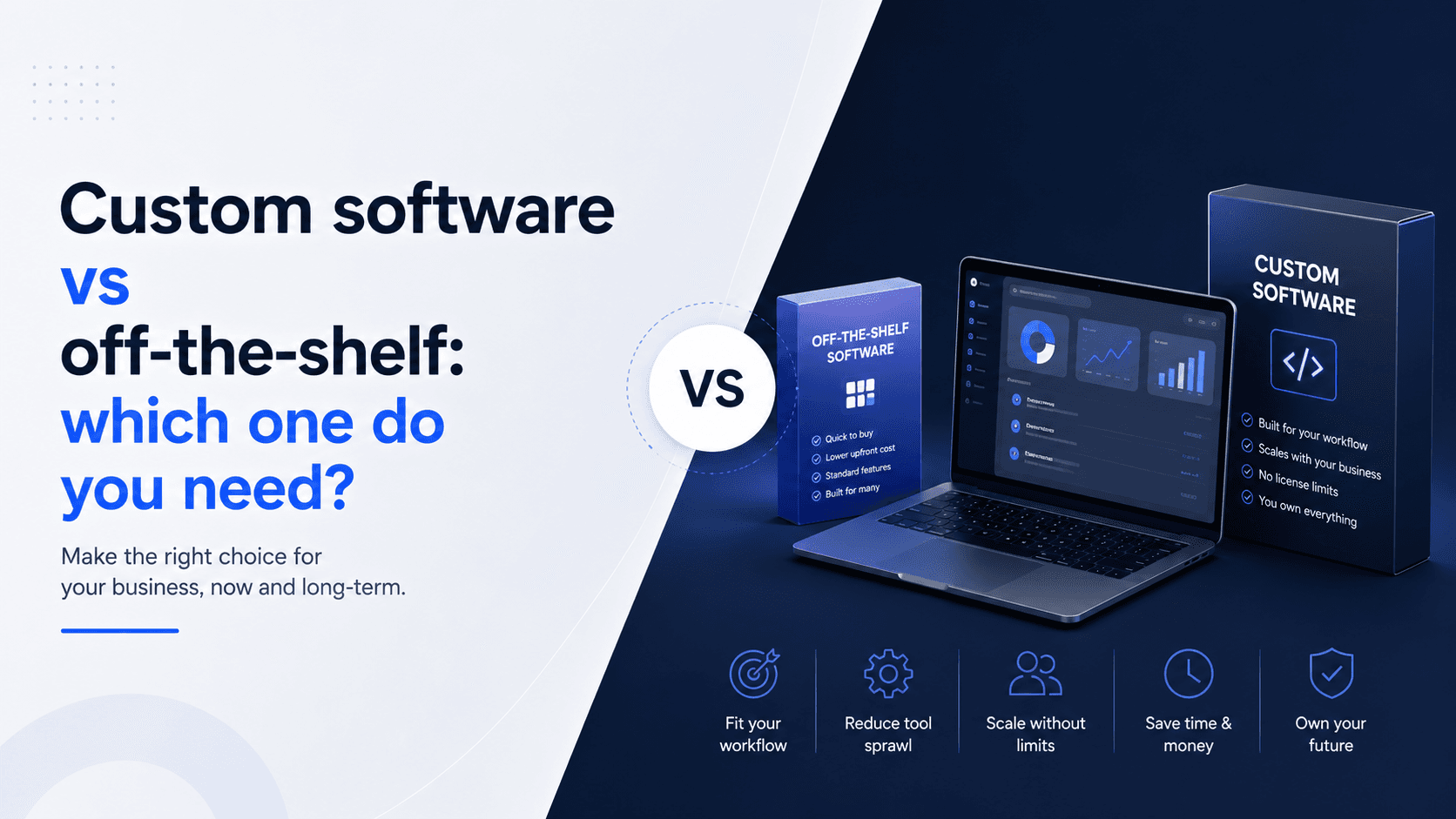
Custom software vs off-the-shelf: which one do you need?
Off-the-shelf wins on speed and upfront cost. Custom wins when your process is your edge. A plain guide, with a test you can run this week.
If an off-the-shelf tool covers 80 percent of what you need, buy it. Custom software makes sense when the missing 20 percent is where your business makes its money, or when you're paying for five tools plus a spreadsheet to glue them together. That's the whole decision in two sentences. The rest of this guide is the detail, including a test you can run this week.
We build custom software for a living, so you'd expect us to push it. We won't. Recommending a build to a company that should buy a subscription creates an unhappy client and a bad reference. Honesty is cheaper.
When off-the-shelf is the right call
Buy, don't build, when the process you're solving is the same for every business like yours.
Accounting is accounting. Email is email. If your sales process looks like everyone else's, a standard CRM will serve you well for a fraction of a build's cost, and it will keep improving without you paying for the improvements.
Off-the-shelf also wins when you need something working next week. A subscription is live the day you sign up. A build takes weeks. And it wins when your team is small and your workflows are still changing monthly, because you don't want to pour concrete around a process you haven't settled yet.
When custom starts to pay for itself
The case for custom shows up in four situations, and usually more than one at once.
The first is when your process is your edge. If the way you quote, schedule, price, or deliver is what wins you customers, forcing it into a generic tool sands off the very thing that makes you different. Software built around your exact workflow protects it.
The second is tool sprawl. We meet companies running six subscriptions with a spreadsheet in the middle and one person who spends every Friday copying data between them. Add up those subscriptions and those hours over three years. The number often funds a build.
The third is per-seat pricing at scale. A tool at $50 per user per month is cheap with 5 people and painful with 80. Custom software doesn't charge you for growing.
The fourth is workflow contortion. If your team keeps a shadow spreadsheet because "the system doesn't do it the way we work", you're already paying for custom software in wasted hours. You're just not getting it.
The costs people forget to count
Both sides of this comparison hide costs, and the honest math includes them.
For off-the-shelf: the subscription never ends, seats multiply as you hire, the vendor can raise prices or retire features, and the workarounds your team invents cost hours that never appear on an invoice. Switching later means migrating years of data out of someone else's format.
For custom: the build cost comes first and it's real, we've broken down the ranges in our custom software development cost guide. Then upkeep, typically 15 to 25 percent of the build cost per year across the industry. And ownership means responsibility: hosting, backups, and someone to call when you want changes. A good partner covers that last part, but it belongs in the math.
What ownership actually changes
Here's the difference that matters most five years out.
With a subscription, your process must follow the tool. When the vendor changes direction, you adapt. With custom software you own, the tool follows your process. When your business changes, the software changes with it, because every line of code, every account, and every piece of data is yours.
We've watched this play out with clients who outgrew a rented tool: the moment they needed one field the vendor didn't offer, the whole system became a ceiling. Owned software doesn't have that ceiling.
A test you can run this week
You don't need a consultant for the first pass. You need an hour and a notepad.
List your five most repeated workflows, the things your team does daily or weekly.
Mark every step that happens in a spreadsheet, a group chat, or someone's memory instead of a proper tool.
Count the hours those marked steps eat per week, across everyone involved.
Multiply by 50 weeks and an honest hourly cost.
If that number is small, keep your subscriptions and move on. If it made you wince, that's the budget conversation, and now it's grounded in your own numbers instead of a vendor's pitch.
Questions we hear a lot
Is custom always more expensive in the long run? No. Upfront, always. Over five years, often not, once subscriptions, seats, and glue-work hours are counted. The crossover point depends on your team size and how badly the rented tools fit.
Can we start small instead of committing to a big build? Yes, and you should. The best first projects replace one painful workflow, prove the value in weeks, and earn the next phase. Big-bang rebuilds are how budgets die.
Could you extend the tools we already use instead of replacing them? Often, yes. Integrations that connect your existing systems and remove the manual copying are some of the highest-return projects we do.
What if we pick wrong? Buying wrong costs a year of subscription and some migration pain. Building wrong costs more, which is why scoping matters and why ours starts with your workflow, never with a feature list.
Run the notepad test first. If the wasted-hours number surprises you, send it to us and we'll tell you honestly whether it justifies a build, a few integrations, or nothing at all. The first conversation is free.