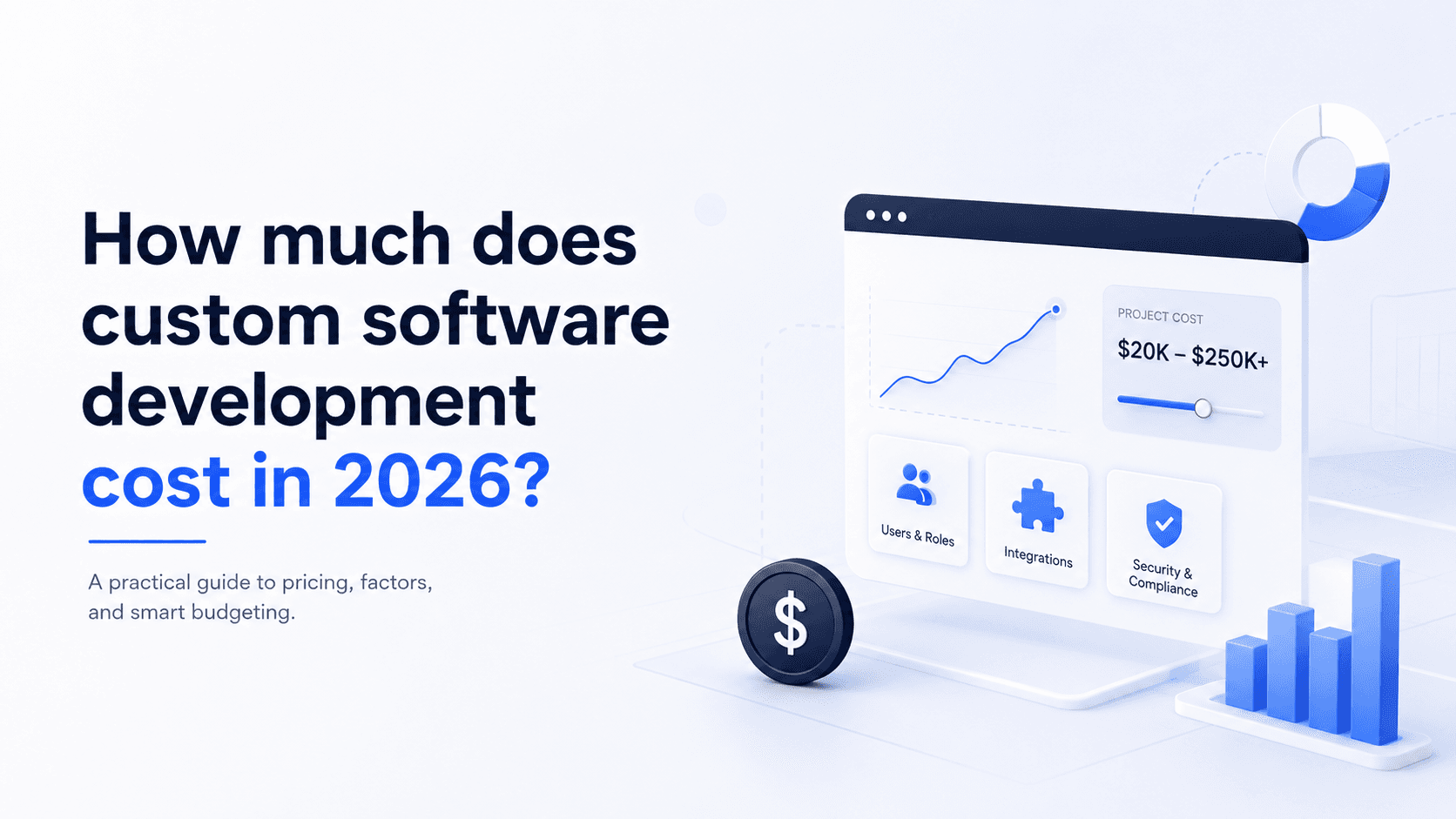
How much does custom software development cost in 2026?
Most custom software projects land between $20,000 and $250,000. Here's what moves the number, and how to keep yours predictable.
Most custom software projects in 2026 land between $20,000 and $250,000. A focused internal tool sits near the low end. A large platform with several user roles, integrations, and reporting sits near the top, and can pass it. The wide range annoys everyone, so this guide breaks down what actually moves the number, and how to keep yours predictable.
One thing before the detail. Any agency that quotes you a precise price before understanding your workflow is guessing. The useful question isn't "what does software cost", it's "what does solving my specific problem cost". That answer can be surprisingly small.
What a typical project costs
Pricing guides from Business of Apps and Topflight Apps put most builds in these bands, and they match what we see in real scoping calls:
A small tool, around $15,000 to $40,000. One core workflow, a handful of screens, one type of user. Think a quoting calculator, a booking system, or an internal dashboard that replaces a painful spreadsheet.
A medium system, around $40,000 to $100,000. User accounts, a database at the centre, two or three roles, and integrations with tools you already use. Most business software lives here.
A large platform, $100,000 to $250,000 and up. Many user types, complex permissions, heavy reporting, mobile apps alongside the web product, or compliance requirements.
These are industry bands, and every project is priced on its own scope. But if a quote sits far outside them in either direction, ask why.
What moves the price up or down
Six things decide most of the number.
Screens and roles come first. Every distinct screen needs design, build, and testing, and every user role multiplies the paths through the product. A tool with 8 screens and one role is a different animal from one with 30 screens and four roles.
Integrations are second. Connecting to your accounting software, payment provider, or CRM is normal work. Connecting to a legacy system with no documented way in is archaeology, and it's priced like archaeology.
Then come platform choice (web only is cheaper than web plus two native mobile apps), design depth (a clean standard interface versus a fully custom brand experience), data migration (moving years of messy records safely takes real time), and compliance (healthcare and finance carry audit and security work that other industries skip).
AI features sit on top of all this. Adding a well-scoped AI capability to a system, like document extraction or an assistant that answers from your data, typically adds four to ten weeks of work. We wrote more about what that involves on our AI software development page.
Why quotes for the same project differ so much
Ask three companies to quote one project and you might get $30,000, $80,000, and $200,000. There are real reasons.
Seniority is the big one. A team of experienced engineers costs more per week and usually finishes faster with fewer expensive mistakes. A cheap team can genuinely cost more by the end, because rework is the most expensive work there is.
Location matters too. Business of Apps puts the average salary of a US-based developer around $110,000 a year, which is why fully US-based agencies quote what they quote. Distributed teams charge less for the same output quality when they're senior. The thing to check is who exactly writes your code, and how experienced they are, wherever they sit.
And quotes hide different things. Some include design, project management, testing, and support. Some are a bare build with everything else billed later. A $50,000 quote that includes QA and 30 days of support can be cheaper than a $35,000 quote that doesn't.
Fixed price or hourly
Hourly billing suits open-ended research where nobody can define the finish line. For most business software, we think you deserve a number before work starts.
Our model is fixed scope, fixed price. We run a scoping session, write down exactly what will be built, and put one price on it. If you change the scope later, the price changes with it, in writing, before the work happens. No meter running quietly in the background.
Whichever model you choose, get the scope in a document you understand. Most budget blowups aren't caused by dishonest vendors. They're caused by two sides holding different pictures of the same project.
What it costs after launch
Software needs upkeep the way a building does. A common rule of thumb, and the one Topflight's 2026 pricing guide uses, is around 15 to 25 percent of the build cost per year for maintenance, updates, and small improvements.
That doesn't mean a mandatory contract. Every custom software build we ship includes 30 days of support, and after that you choose: a retainer if you want us close, or full handover, since you own all the code and accounts anyway.
How to keep your budget under control
A few habits save more money than any negotiation.
Start with the problem, and let the feature list be an output of it. "Reduce time spent on quotes" scopes tighter than "build us a quoting module with 14 features".
Ship a first version that does one thing well, then fund phase two from what real users actually ask for. Half of the features people plan upfront never get used.
Ask for a fixed-scope quote with QA, project management, and support spelled out.
Keep one decision-maker on your side. Committees change scope, and scope changes cost money.
Questions we hear a lot
Can I get real software built for under $10,000? Sometimes. A single automation, a small integration between two tools, or an add-on to an existing system can land there. A full product with accounts and payments almost never does, and a vendor promising one that cheap is cutting things you'll pay for later.
Do I pay everything upfront? No. Sensible projects bill by milestone, so payment tracks working software you've actually seen.
Why can't anyone give me a price from one phone call? Because the price is the scope. What a serious team can give you quickly is a range, then a fixed number after a short scoping exercise.
Does a bigger budget mean a better product? Past a point, no. Fit beats size. A $60,000 system built around your exact workflow will outperform a $200,000 platform your team fights daily.
The fastest way to get a real number for your project is a scoping conversation, and ours is free. Tell us what you're trying to fix and we'll come back with a clear range, in plain language, usually within a day.