Fixed price vs time and materials in software projects
Fixed price protects your budget when the scope is clear. Time and materials suits work you can't define yet. How to choose, and the hybrid most teams use.
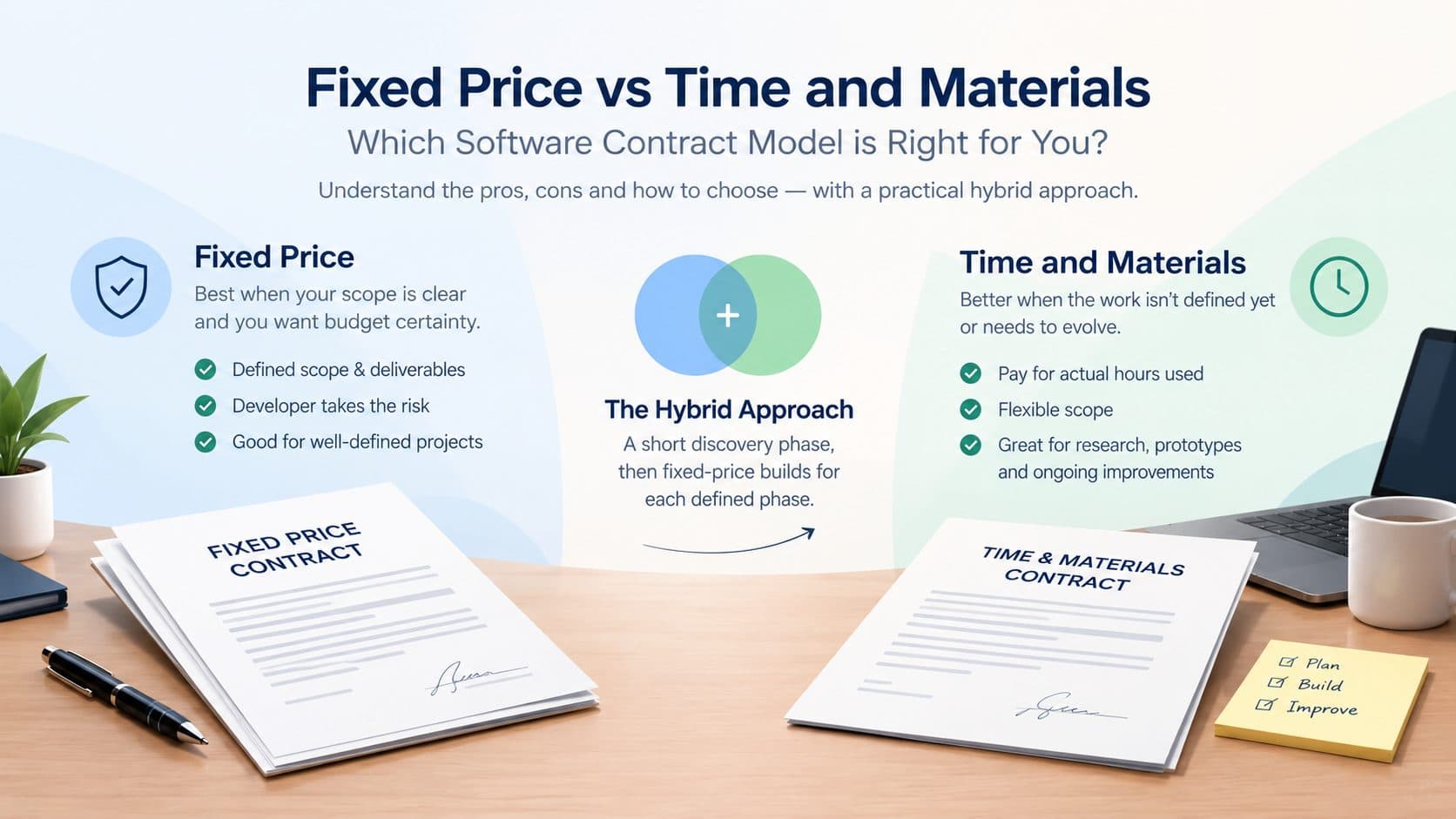
A fixed-price contract is safer for you when you can describe what you want in writing before work starts, because the risk of overruns sits with the developer. Time and materials is better when the work can't be defined yet, such as research, early prototypes or ongoing improvements, because you only pay for the hours actually used. Most good projects combine them: a short paid discovery phase, then fixed prices for each defined phase.
The model matters less than people think. What protects you is a clear scope and an honest process for changes. Here's how each model works in practice.
How a fixed-price contract works
You and the developer agree on a written scope: the screens, features, integrations and what "done" means. The developer quotes one price for that scope. If the work takes longer than they estimated, that's their problem, not yours.
It suits projects where:
You know what you want, even if you don't know how to build it.
The budget is fixed, such as a grant, a board-approved number or a founder's savings.
You want to compare quotes from several studios fairly.
The catch is change. Every fixed-price contract needs a change process. When you think of something new halfway through, and you will, it gets described, priced and approved in writing before anyone builds it. A good studio makes this easy and quick. A bad one uses it to claw back money they lost by underquoting.
How time and materials works
You pay for the hours worked, usually at an hourly or daily rate per person, and you see a timesheet or a weekly report. The scope can change every week without paperwork.
It suits work where:
Nobody can predict the effort honestly, like exploring whether an AI model can handle your documents.
The product is live and you want a steady stream of improvements.
You have someone on your side who can direct the developers week to week.
The risk sits with you. If the work takes twice as long, you pay twice as much. Time and materials works best when you have a technical person reviewing progress, or when you trust the team from previous work.
Where each model goes wrong
Fixed price fails when the scope is vague. "An app like Uber, but for tutors" can be quoted at $20,000 or $200,000, and both quotes are honest guesses about different apps. The low bidder then fights you on every detail to protect their margin.
Time and materials fails when nobody is steering. Without clear weekly goals, hours drift into polishing things that don't matter, and the invoice grows with no product to show for it.
Both failures have the same root cause: nobody wrote down what success looks like before the money started moving.
Picture a founder who gets three quotes for the same idea: $18,000, $45,000 and $90,000. They pick the middle one. Two months in, it turns out the $45,000 quote assumed a simple admin panel, email login only and no payment integration, while the founder assumed all three. The contract was fixed price, but the scope was a paragraph. The project ends up costing more than the $90,000 quote would have, and it ships late.
The cheapest protection is a scope document detailed enough that two studios reading it would build roughly the same thing. That document usually costs a small fraction of the build, and it's the most useful thing you'll pay for.
What a good scope document contains
You don't need a 60-page specification. For most business software, a good scope covers:
The people who use the product and what each of them needs to do.
Every screen or page, with a sentence or two on what it's for.
The integrations: payment gateways, CRMs, accounting tools, email and SMS providers.
What's out of scope for this phase, written down explicitly.
How the work will be accepted: who tests it, against what, and how long they have.
The "out of scope" list prevents more arguments than anything else in the contract.
The hybrid most teams end up using
The model we recommend to most clients, and the one we use ourselves, splits the project in two:
Discovery, usually one to three weeks: we map the users, the flows and the risky parts, and produce a written scope. This part is small and short on purpose.
Build, in fixed-price phases: each phase has its own scope, price and delivery date, so you always know what the next payment buys.
This gives you the budget certainty of fixed price without pretending anyone can foresee six months of product decisions on day one. It also gives you exit points. If the first phase doesn't go well, you haven't committed the whole budget.
We quote fixed prices for our custom software projects and SaaS builds after a free scoping call, and changes are priced in writing before any work on them starts.
How to protect yourself under either model
Whichever contract you sign, a few clauses do most of the protecting:
Code ownership: the contract should say the code, designs and accounts belong to you, and repositories should be in your name from day one.
Milestones tied to working software: pay against things you can click through, not against "backend 60% complete".
A change process in writing: how changes are requested, priced and approved.
A warranty or support period after launch, so bugs found in the first weeks get fixed without a new contract.
An exit clause: what happens to the code and the money if either side walks away.
If a studio resists any of these, that tells you something. We cover more of these checks in how to hire a software development company.
Questions about software contract models
Is fixed price more expensive than time and materials?
Often slightly, because the developer adds a buffer for the risk they carry. But the final cost is frequently lower, because a fixed-price project has a clear scope, and scope drift is what makes time and materials projects expensive.
Can a fixed-price project change scope?
Yes, through change requests. Each change is described, priced and approved in writing before work starts. The original price stays fixed for the original scope.
Which model is better for an MVP?
A short discovery followed by a fixed-price build works well for most MVPs. You get a defined first version on a known budget, and you keep the flexibility to change direction after launch.
What is a dedicated team model?
It's a variant of time and materials where you pay a monthly fee for a set of people working only on your product. It suits companies with a long roadmap and someone in-house to direct the work.
Get a fixed quote for your project
If you have a project in mind, tell us what you want to build. After a free scoping call you'll get a written scope and one fixed price, and you can compare it with anyone else's.