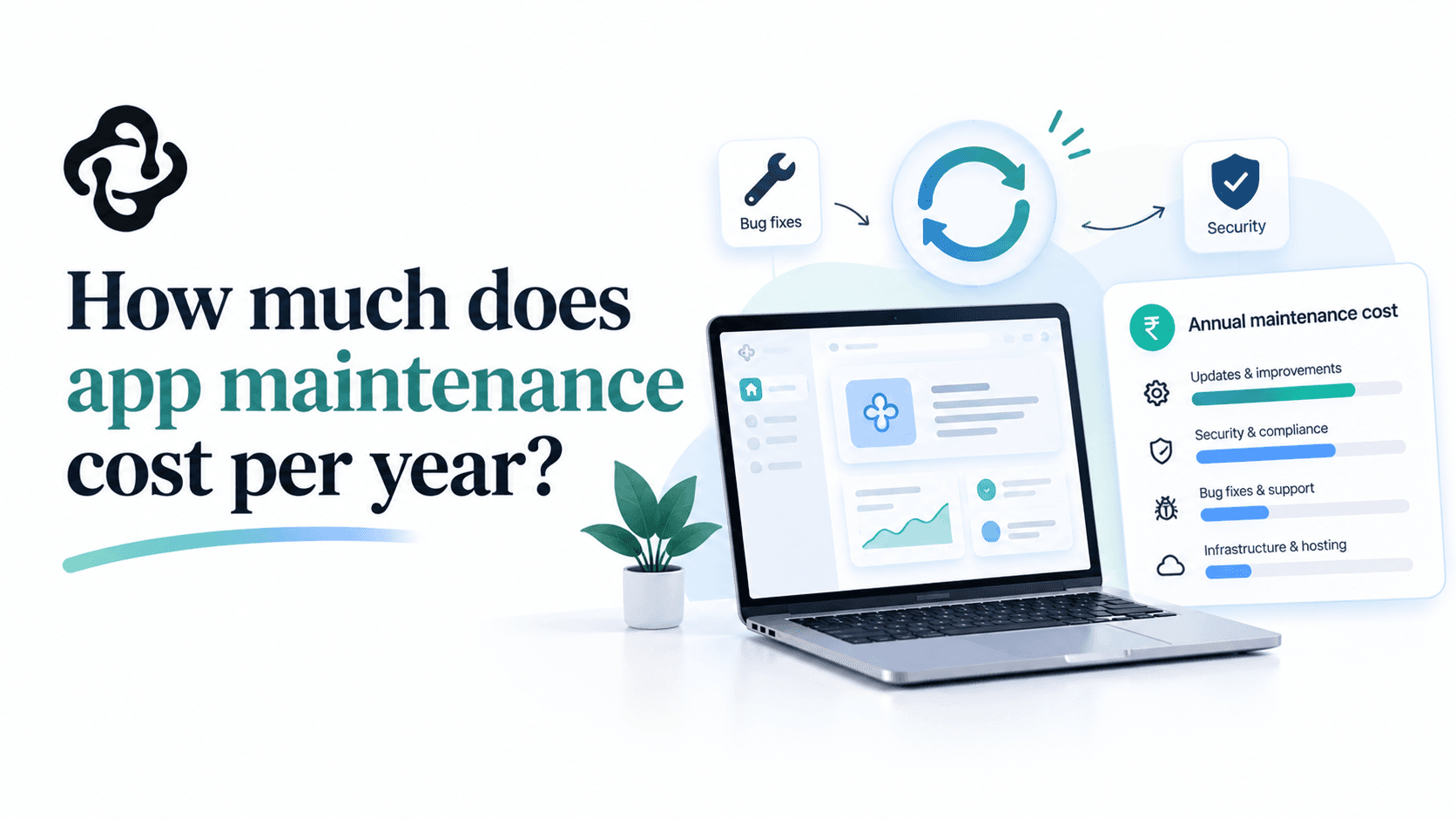
How much does app maintenance cost per year?
Budget 15 to 20% of the original build cost every year. A $60,000 app needs about $9,000 to $12,000 a year to stay secure and in the stores.
App maintenance usually costs 15 to 20% of the original build cost per year. So an app that cost $60,000 to build needs roughly $9,000 to $12,000 a year, and a $150,000 app needs $22,000 to $30,000. That covers hosting, third-party services, operating system updates, security patches and small fixes. New features are extra.
That percentage is a rule of thumb, and plenty of apps land outside it. A simple app on managed services can sit closer to 10%. An app with heavy traffic, lots of integrations or strict compliance needs can pass 25%. Here's what actually drives the number.
What you're paying for every year
Maintenance isn't one cost. It's five or six smaller ones that arrive at different times.
Hosting and infrastructure: servers, databases, file storage and bandwidth. A small app can run on $50 to $300 a month. A busy one can spend a few thousand.
Third-party services: maps, SMS, email, push notifications, payment fees, analytics and error tracking. These are often priced per use, so they grow with your users.
Store fees: Apple charges $99 a year for a developer account. Google charges a one-time $25.
Operating system updates: Apple ships a new iOS every September and Google raises its minimum Android target every year.
Security and dependency updates: the libraries your app is built on get patched constantly, and some patches fix serious holes.
Bug fixes and small changes: the steady trickle of "this button is broken on the Samsung A15" reports.
The first three are predictable. The last three are where budgets surprise people.
Here's how that might add up for a typical business app that cost $60,000 to build and has a few thousand active users. Hosting and backend services at around $200 a month come to $2,400 a year. Email, SMS, maps and monitoring add perhaps $1,500. The yearly iOS and Android updates take one to two weeks of developer time. Security patches, library updates and a steady flow of small fixes take a few days each quarter. Put together, that lands close to $10,000, which is where the 15 to 20% rule comes from.
Your numbers will differ. An app that sends thousands of SMS messages a day, or streams video, can spend more on services than on developers. An internal tool used by 30 staff might cost almost nothing to host.
The yearly updates you can't skip
Two deadlines hit every app, every year.
On Android, Google requires new apps and updates to target a recent Android version. From 31 August 2026 that means Android 16 (API level 36). Miss it and you can't publish updates, which means you can't fix bugs either. Existing apps also need to target at least Android 15 to stay visible to new users on newer phones.
On iOS, Apple requires apps to be built with a recent SDK. From 28 April 2026, uploads to App Store Connect had to be built with the iOS 26 SDK. Apple has moved this line every spring, so expect the iOS 27 SDK to become the minimum in 2027.
Neither update is optional, and both can take anything from a day to a few weeks depending on how old your app's code and libraries are. An app that's been updated regularly moves quickly. An app nobody touched for two years often needs its framework upgraded first, which is where the cost jumps.
Three ways to pay for maintenance
Most studios offer some version of these:
Pay as you go: you call when something breaks and pay by the hour. Cheapest in quiet years, most expensive in bad ones, and nobody is watching the app in between.
Monthly retainer: a fixed number of hours each month for updates, monitoring and fixes. Predictable, and someone knows your code.
Annual plan: a fixed yearly fee for a defined list of work, such as OS updates, security patches and uptime monitoring, with extra work quoted separately.
For most business apps, a small retainer is the sweet spot. It keeps a developer familiar with your codebase, so a two-hour fix doesn't turn into a two-day re-learning exercise.
How to keep maintenance costs down
Maintenance cost is decided mostly at build time. A few choices make a big difference:
Use managed services for hosting, databases and authentication, so security patches happen without your team.
Keep the number of third-party libraries sensible. Each one is something that can break on the next OS update.
Write automated tests for the flows that make money, like signup and checkout. They turn a nervous afternoon of manual testing into a ten-minute check.
Add error monitoring from day one, so you hear about crashes from a dashboard and not from one-star reviews.
This is part of why we give every app we build 30 days of post-launch support and hand over clean documentation. The next developer, whether that's us or someone else, shouldn't have to guess.
What happens if you skip maintenance
Nothing, for a while. Then several things at once.
The app stops receiving updates in the Play Store because of an outdated target API. A payment library stops working because the provider retired an old version. A new iPhone screen size makes a key button unreachable. Each of these is a small fix on a maintained app and a large project on a neglected one.
We see this often with apps that come to us after a year or two without care. The rescue work frequently costs more than two years of maintenance would have. If your app is in that state, our web and app development team can review it and tell you whether it needs a tune-up or a rebuild.
Questions about app maintenance costs
Is app maintenance a one-time cost?
No. It's a yearly cost for as long as the app is live, because operating systems, libraries and third-party services keep changing. Budget for it before launch, the same way you'd budget for rent.
How much does it cost to host a mobile app?
Most small business apps spend $50 to $300 a month on hosting and backend services. Apps with heavy media, real-time features or many users can spend several thousand a month. Usage-based services grow with your audience, so review the bill every quarter.
Does maintenance include new features?
Usually not. Maintenance keeps the existing app working, secure and in the stores. New features are scoped and priced separately, although small improvements often fit inside a monthly retainer.
Can I maintain my app myself?
If you're a developer, yes. If you're not, you'll need someone who can update the code for OS changes and security patches. Hosting dashboards can be managed by a non-technical owner, but store compliance updates can't.
Get a maintenance estimate for your app
Send us your app's store links and a rough idea of how many people use it, and we'll give you a yearly maintenance estimate with what's included and what isn't. The first call is free.